
Dead Parrots and Old Trees: A Conference Report from the Minding Animals Germany Symposium 2025

Updated: Dec 15, 2025
A few years ago, animals crept into the Nuremberg University of Music, settled in, and became an integral part of the university landscape, as they have elsewhere in international academic life. We owe this to Human-Animal Studies, the scientific field of research that examines animals as subjects, but also as active, feeling, and thinking co-creators of a shared world. A whole range of disciplines, from philosophy and animal ethics to biology, from cultural studies to veterinary medicine, from social and political science to musicology, have turned their attention to animals. This often involves interdisciplinary work and questioning and crossing transdisciplinary boundaries by incorporating approaches and topics from academia into society, for example through collaborations with artists and activists. The focus is both on critically examining existing human-animal relationships and on exploring ethical utopias for the future, as expressed, for example, in the large-scale Utopia paintings by Hartmut Kiewert.
![[Poster Hartmut Kiewert, Strand IV, 2025, oil on canvas]](https://static.wixstatic.com/media/164de4_e8dee65e64cb4f5fb0321204ce24b831~mv2.jpg/v1/fill/w_980,h_1611,al_c,q_85,usm_0.66_1.00_0.01,enc_avif,quality_auto/164de4_e8dee65e64cb4f5fb0321204ce24b831~mv2.jpg)
One of his paintings also adorned the poster for this year's Minding Animals Symposium. Organized by Minding Animal Germany, a subsection of Minding Animal International, the world's largest interdisciplinary and transdisciplinary network in human-animal studies, the German-speaking community was hosted by the Nuremberg University of Music from October 24-25, 2025.
A diverse program was presented at a high academic level following the welcome address by Renate Reitinger (Vice President for Studies, Teaching, and Research at the University of Music) who emphasized how relevant and promising the event was for her university. Martin Ullrich (Professor of Interdisciplinary Music Research and Human-Animal Studies) and myself (Judith Benz-Schwarzburg, an animal ethicist based at Vetmeduni Vienna as well as Speaker of Minding Animal Germany) opened the conference and handed over to Ute Hörner (Academy of Media Arts Cologne) for the opening lecture. Hörner took the audience on a journey through the colonial collections of our natural history museums, where African grey parrots, like many other representatives of rare and “exotic” species, are sorted and preserved in the drawers of huge basement archives.
Killed decades ago, the parrots are neatly numbered witnesses to humanity's thirst for knowledge and the colonial practice of exploring distant lands and foreign species. Nevertheless, the animals appear as if laid out in state and are at the same time also witnesses to their own individuality, as Hörner's artistic processing of the drawings and videos from her expedition into these collections impressively demonstrates.
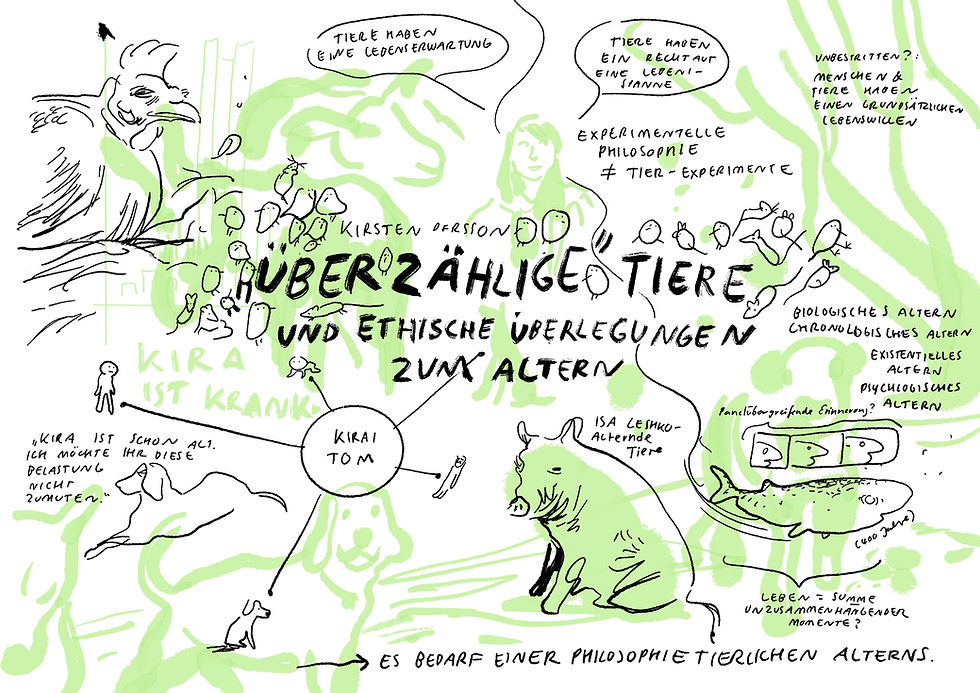
The conference program of the following two days featured a big variety of perspectives, approaches and topics. A panel on “Animals in Politics, Culture, and Activism” turned the attention to human-animal practices that claim to be intangible cultural heritage (have you ever heard of the Harzer Finkenmanöver? or the Harzer Rotvieh?) Further highlights included a panel on “Animals in Design” with a talk on the preservation of old habitat trees. Such trees, home to many animals, are becoming a pressing topic, especially in large cities such as Hamburg, which are performing a balancing act between land sealing and green space design. A panel on “Virtual Animals” offered critical perspectives on certain normalized practices in computer games such as Minecraft, where the breeding, keeping, and mass killing of farmed animals is sometimes deliberately undermined by some players’ attempts to play vegan runs. The last two speakers, finally, addressed the opportunities offered by Ubuntu philosophy for overcoming speciesism and dealt with questions of aging in companion animals. Here, too, we are confronted with far-reaching social changes in view of veterinary geriatric treatment options, increasing high-tech medicine, and a growing range of products on the pet market (from age-appropriate food and health insurance to funeral services for pets).
A total of 16 experts from the fields of science, arts, and activism from Germany, Austria, and Switzerland contributed to this conference and offered many exciting ideas for reflection, further research projects, and (often urgently needed) socio-political implementation. Next year, the conference will meet again at the Academy of Media Arts Cologne, where we can look forward to another diverse, high-caliber, and inspiring program.


Comments