
Mercy and Animals: Why Compassion Still Matters in a Technological Age


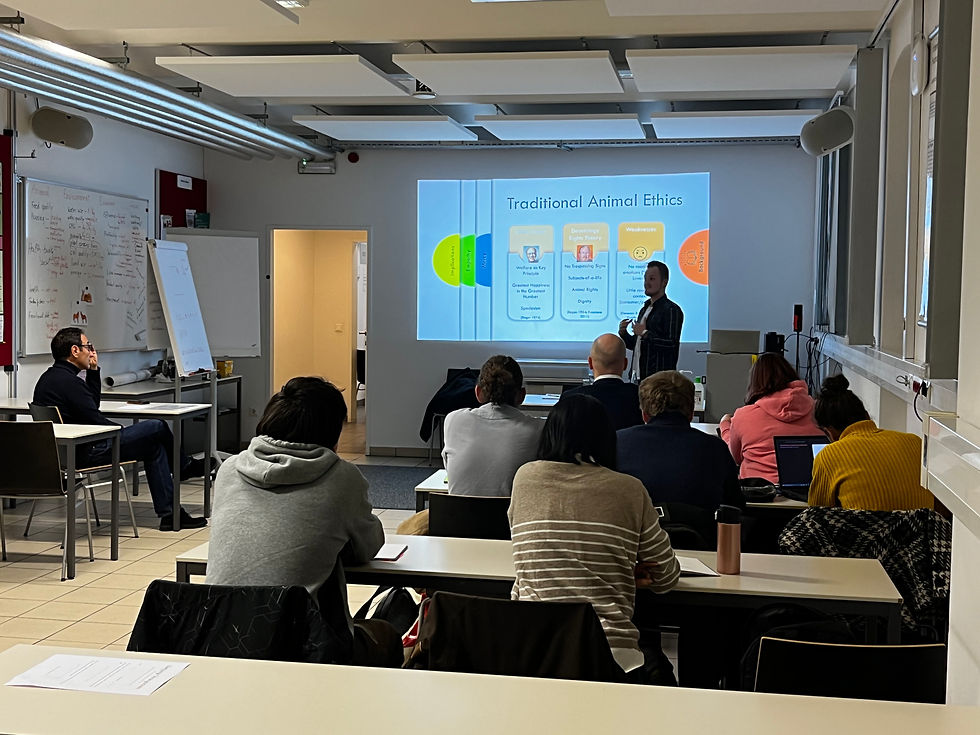
Leon Borgdorf at the Messerli Research Institute (Photo Credit: Thomas Kainberger)
On December 1st, Leon Borgdorf gave a talk at the Messerli Research Institute on mercy as a fundamental virtue in animal ethics. Leon, a PhD candidate at Utrecht University, works on the ethics of emerging technologies in animal agriculture — especially genome editing — and looks at these issues through the lens of virtue ethics. Instead of focusing only on rules or consequences, virtue ethics asks what kind of person one should strive to be. What habits, emotions, and everyday choices make someone compassionate, fair, or responsible?
In his presentation, Leon argued that mercy is not a decorative add-on to our moral lives, but a basic starting point – a virtue that can support and shape all the others. The talk was based on Leon’s recent article, Mercy – a Central Virtue in Animal Ethics, co-authored with Koen Kramer and Franck Meijboom.
The article’s core claim is simple but far-reaching: mercy means choosing not to harm someone who is vulnerable to us, even when we easily could. When it comes to animals – especially farmed animals – this vulnerability is everywhere. They depend on us for food, shelter, and safety. And often, they are quite literally at the mercy of human decisions that determine how they are kept, handled, and ultimately whether they live or die.
A key point in the talk was that mercy grows out of a particular emotional capacity: empathic concern. This is a very down-to-earth kind of empathy – not about mind-reading or imagining grand scenarios, but about feeling moved when another being is in distress, and feeling a pull not to cause harm. Studies in psychology suggest that most humans have natural “inhibitions against violence”: harming others usually feels wrong, and it actually takes work, training, or desensitisation to get around that instinct.
To illustrate this, Leon drew a striking comparison from military ethics: soldiers often need explicit training to suppress their empathy in order to kill. This can involve euphemistic language, mechanical routines, and various forms of emotional distancing. Something similar happens, he argued, in slaughterhouses. Killing animals at high speed, working with heavily mechanised systems, and using distancing language (“processing,” “harvesting,” “beef,” “pork”) can slowly numb workers to the lives in front of them. Over time, this does not only harm animals – it can also injure the moral character and psychological well-being of the humans involved.
From a virtue-ethical perspective, this matters because mercy is understood as a stable character trait: a habit of choosing not to harm, supported by the right emotional responses at the right moments. Mercy is also a kind of baseline for other virtues. We can’t meaningfully call ourselves kind, compassionate, or caring if we aren’t at least minimally committed to not harming vulnerable beings when we have the choice.

(Photo Credit: Thomas Kainberger)
A lively discussion followed Leon’s talk. Participants debated what exactly “mercy” should mean in everyday practice, how far its scope should extend, and whether it is truly a universal concept or something that depends on culture and context. Others wondered whether virtue ethics — with its focus on character, emotion, and relationships — offers a realistic guide for animal ethics in comparison with familiar frameworks like utilitarianism or rights-based theories. There was also interest in how Leon’s idea of mercy might influence his ongoing work on genome editing: can new technologies actually support a more merciful agriculture, or do they risk papering over deeper moral problems? And if mercy is so tightly linked to empathy, can highly technical interventions ever help us become more emotionally responsive to the animals in our care?
By the end of this discussion, it was clear that far from being an old-fashioned or sentimental idea, mercy offers a powerful lens for thinking about our responsibilities to animals and for thinking about the kind of society we want to build. In a world where technological possibilities are expanding rapidly, Leon’s talk was a reminder that the heart of ethics may still lie in something very simple: the everyday choice not to harm those who depend on us.

(Photo Credit: Thomas Kainberger)


Comments